Lisotrigona: The Smallest Stingless Bee, Explained
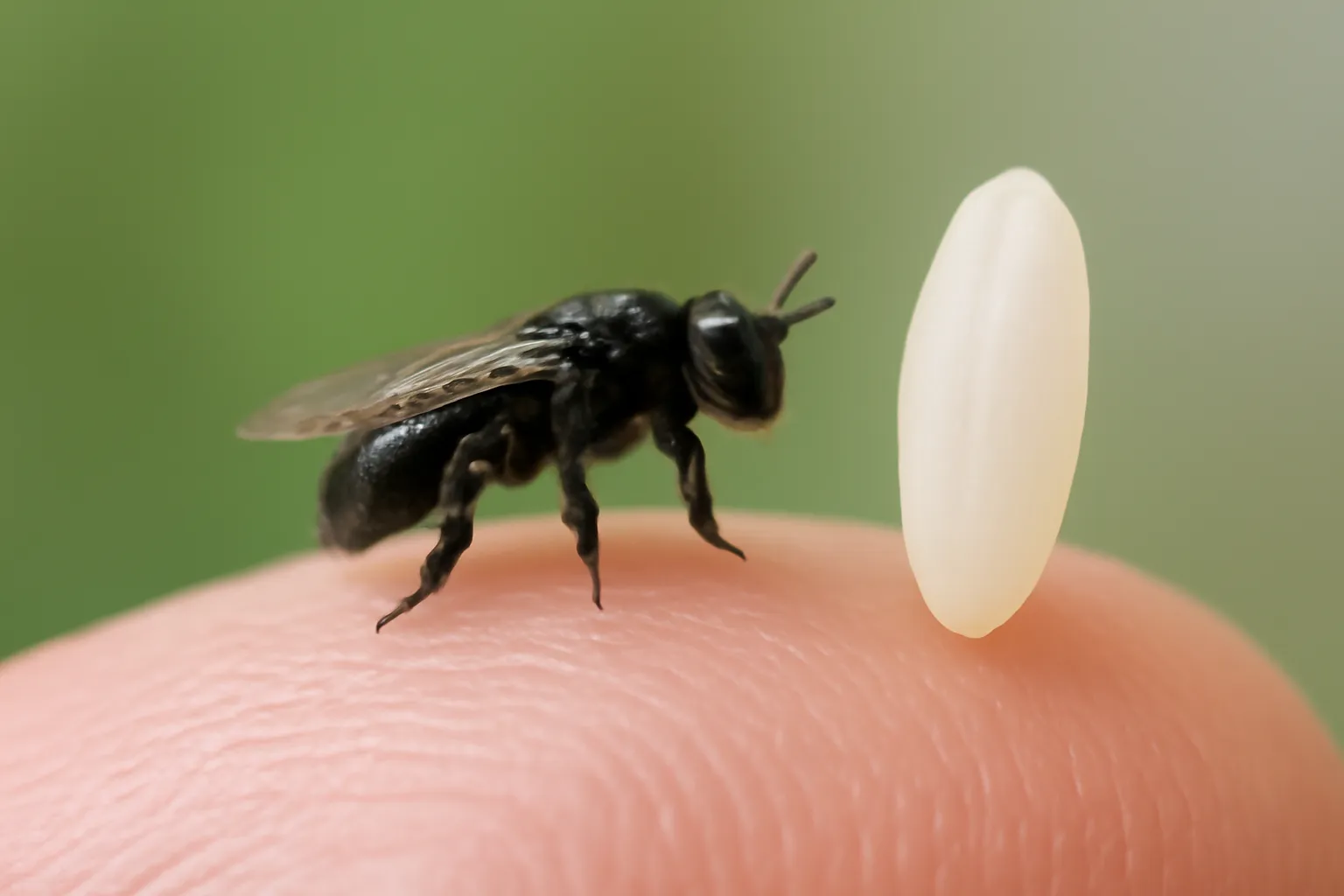
Lisotrigona is a genus of stingless bees found in parts of southern and southeast Asia, and its workers are among the smallest bees anywhere: shorter than a grain of rice and easy to mistake for a gnat. Compared with Tetragonula, the stingless bee most keepers in Vietnam start with, Lisotrigona lives in smaller colonies, stores far less honey and is much harder to keep in a box.
Visitors to the farm sometimes notice a speck hovering near their face and ask whether that is a bee. Sometimes it is. This article explains what Lisotrigona is, how it differs from the bees in our boxes, what it gets confused with, and why we rarely suggest it as anyone’s first colony.
Where Lisotrigona fits among stingless bees
Stingless bees form the tribe Meliponini, a large group of bees found across the tropics whose sting is so reduced that it cannot be used for defence. Within that tribe there are many genera (a genus is a group of closely related species). In Vietnam the one most people keep is Tetragonula, small dark bees that nest in cavities and build resin entrance tubes. Lisotrigona is a separate genus, much less familiar even to keepers.
Its most famous trait is behavioural. Researchers working in Thailand documented some Lisotrigona species drinking tears from the eyes of animals and people, a habit called lachryphagy. It sounds alarming, but the bees are simply collecting moisture and salts; they do not sting and cannot hurt the eye in any serious way, though a bee at the corner of your eye is undeniably distracting. If you feel unwell or have an eye problem, that is a question for a doctor, not for a beekeeper.
Which Lisotrigona species live in Vietnam, and where exactly, is not something we can state with confidence. The genus is recorded from mainland southeast Asia, and very small stingless bees are certainly seen in Vietnamese gardens and forests. But telling the tiniest species apart reliably needs a specialist and a microscope, and the published picture is incomplete. We would rather say that plainly than give names we cannot stand behind.
In everyday Vietnamese, very small bees are often called ong muỗi, literally mosquito bees. The name is used loosely and can cover several kinds of tiny stingless bee, so hearing it does not tell you which genus you are looking at.
How Lisotrigona differs from Tetragonula
Size. A Lisotrigona worker is noticeably smaller than a Tetragonula worker, which is itself a small bee. Side by side, the difference is obvious even without a lens.
Colony size. Lisotrigona colonies tend to be small. A box that would look half empty with Tetragonula may be a normal home for them.
Honey stores. Their honey pots are tiny and few. A colony keeps enough for itself, and there is rarely anything a keeper could take.
Nest sites. They are often reported in small cavities, cracks and narrow hollows where larger bees would not fit.
Entrances. The entrance can be little more than a pinhole, sometimes with a small resin collar. It is easy to walk past without noticing.
Growth rate. Small colonies build slowly. Splitting them to make new colonies is rarely practical for ordinary keepers.
Sensitivity to disturbance. With few bees and small stores, a colony has little reserve. Opening the nest often sets it back more than it would a Tetragonula colony.
Defence. Tetragonula guards will bite and tangle in hair when the nest is disturbed. Lisotrigona are so small that defence is mostly about hiding.
Pests. Ants and other small predators are a bigger threat to tiny colonies, because there are fewer guards to resist them.
Behaviour around people. Some species visit faces for sweat or tears, which Tetragonula workers generally do not.
Availability. Propagated Lisotrigona colonies are rarely offered for sale. Most starter colonies on the market, including ours, are Tetragonula.
Body of knowledge. Far more is known about keeping Tetragonula. With Lisotrigona, even experienced keepers are often still learning.
What readers abroad confuse them with
Gnats and small flies. Hovering tiny insects are usually flies. A bee has four wings, antennae that bend at an elbow, and often carries pollen on its hind legs.
Sweat bees. In many countries small bees that land on skin to drink sweat are called sweat bees, but most are not stingless bees and belong to a different family.
Other “mosquito bees”. The nickname mosquito bee is used for tiny stingless bees in several countries, for different genera. It is not a scientific name.
Australian sugarbag bees. Readers in Australia may know Tetragonula from their own native stingless beekeeping. Those are larger than Lisotrigona and much closer to what we keep.
Fig wasps. Tiny wasps around figs are a separate group altogether, linked to fig pollination.
Ants with wings. Winged ants appear at certain times of year and can look bee-like at a glance. Their narrow waist gives them away.
Young Tetragonula workers. Newly emerged Tetragonula can look paler and smaller than older bees, but they are still bigger than Lisotrigona.
Honey bees. There is no real risk of confusion with honey bees, which are many times larger and do sting.
Thrips. These tiny slender insects are common on flowers, including coffee blossom, and are often mistaken for something else.
Fruit flies. Around kitchens and fruit trees, small hovering flies are far more likely than bees.
Any tiny insect at your eye. Not every insect that goes for your eyes is a Lisotrigona. Flies do it too, and far more often.
Should you start with Lisotrigona?
For almost everyone, no. A beginner learns by watching a colony change: traffic at the entrance rising and falling, pollen colours shifting with the season, honey pots filling. Tetragonula gives you all of that on a scale you can see. Lisotrigona gives you a pinhole and a handful of specks, and when something goes wrong there are few signs until it is too late.
There is also the matter of where colonies come from. Because propagated Lisotrigona are scarce, colonies offered for sale may have been taken from wild nests. We explain elsewhere why we do not take wild colonies from the forest, and that reasoning applies with extra force to a genus so small and slow to recover.
If you are genuinely drawn to these tiny bees, the best way to enjoy them is often simply to notice them. Look for minute entrances in old walls and fence posts, watch which flowers they visit, and leave the nests alone. Many keepers say their interest in the smallest bees began with exactly that kind of patient watching.
If you already keep Tetragonula successfully for a few seasons and want to learn more, talk to keepers who have worked with small species before trying anything yourself. Ask honestly how their colonies have fared over time, not just how they looked in the first month.
If you think you have a Lisotrigona nest at home
Leave it undisturbed. A small colony in a wall crack or a fence post does no harm to the structure in the way termites would.
Take a close photo from a distance. A phone camera with zoom can show the entrance and a few bees. That is often enough for an experienced keeper to give an opinion.
Do not seal the hole. Blocking the entrance traps and kills the colony inside.
Do not spray insecticide. There is no reason to, and it can harm other beneficial insects nearby.
Keep ants in mind. If you see ants raiding the entrance, there is little you can safely do. Let nature take its course rather than breaking in.
Plant small flowers nearby. Tiny bees visit tiny flowers. Herbs left to flower and small weeds are useful to them.
Tell the household. Let others know the specks near the wall are bees, not something to swat.
Avoid pressure washing that wall. High-pressure water can flood a small nest.
If building work is planned, ask for advice early. A keeper may suggest how to work around the nest or whether it can be saved.
Do not try to transfer it yourself. Breaking into a small cavity usually destroys the nest.
Enjoy what you have. Few people realise they share their home with one of the smallest bees in the world.
Frequently asked questions
Is Lisotrigona the smallest bee in the world?
It is among the smallest bees known, and certainly among the smallest stingless bees. Which single species holds the record is a question for specialists, but Lisotrigona workers are tiny by any standard.
Do Lisotrigona bees really drink human tears?
Some species have been documented doing so in Thailand. They are collecting moisture and salts, they do not sting, and the behaviour is more distracting than dangerous.
Can you harvest honey from Lisotrigona?
Not in any meaningful amount. Their colonies keep very little honey, and taking it would put the colony at risk.
Does MoraBee sell Lisotrigona colonies?
Our starter colonies are Tetragonula. Lisotrigona is rarely available as a propagated colony, and we do not recommend it for beginners.
Are Lisotrigona and Tetragonula related?
Yes, both belong to the stingless bee tribe Meliponini, but they are different genera. They differ in size, colony size, honey stores and how easy they are to keep.
Written by the team behind a working stingless bee farm about 40 km from Ho Chi Minh City, Vietnam. Articles come from day-to-day work at the farm; technical figures are stated as ranges, not promises.
About the team →
Buy a Stingless Bee Colony in Lam Dong: Price and Pickup
A starter stingless bee colony from Ong Moc, our farm in Ta Dung, Lam Dong, costs 2.900.000₫. You collect it in its closed box at the farm, ideally on
Why Not Take a Wild Stingless Bee Colony From the Forest
Cutting a wild stingless bee nest out of a forest tree usually kills the tree section, often kills the colony, and removes one of the forest’s own pol

Can a Highland Stingless Bee Colony Live in the Lowlands?
Yes, a stingless bee colony from the cool Lam Dong highlands can live in Saigon or on the coast, because the same kinds of bees also live in the lowla
Stingless Bees for a Coffee Farm: Is It Worth It?
A few stingless bee colonies can sit happily on a coffee farm and work the blossom, but only if the farm’s spraying habits change to protect them. Whe
Settling a Stingless Bee Colony in the Rainy Season
You can settle a new stingless bee colony during the rainy season, but the risks are real: a wet box, little forage and a colony living on its stores.
 ›
×
›
×

MoraBee is the international name of Ong Moc, a stingless bee farm in Ta Dung, Lam Dong, among forest and coffee gardens: unblended honey in clean jars, starter colonies, and farm visits.
Vietnamese stingless bee honey from the highlands
A brand by Tên Miền Đẳng Cấp
© 2026 MoraBee. All rights reserved. · Copyright · OD-3864-C503